By Jennifer Kalish
EDITORIAL INTERN
Published: November 7, 2013 4:00 pm ET
Updated: November 7, 2013 4:09 pm ET
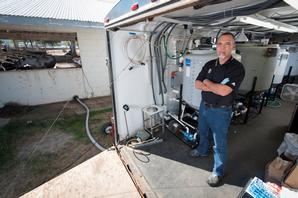
Image By: University of Idaho
Erik Coats
Making plastic from renewable resources is no new feat. But for the past six years, scientists at the University of Idaho have been working diligently to tap into one biomass resource that has yet to be exploited in the plastics industry: dairy manure.
"Back during my Ph.D. work I had the opportunity to explore this concept of converting organic waste to these biodegradable biological plastics known as polyhydroxyalkanoates, or PHA," said Erik Coats, professor of civil engineering at the University of Idaho and lead scientist on the project. "In Idaho, the dairy industry is a very prominent part of the economy, so it was a perfect fit for our bio-plastic research."
Unlike most bioplastics, the PHA that Coats creates is sourced from crops that would not otherwise be used as food for humans and livestock.
"We were looking for a candidate waste stream that had a lot of carbon, a lot of electrons, and that would be readily available and in need of mitigating," he said. "We've been focusing on dairy manure since 2007, about six years."
The process works by fermenting the carbohydrate-rich dairy manure to produce organic acids, which are recovered through a solids separation process. The organic acids are then fed excessively to a tank-full of wild bacteria, sourced from a local wastewater treatment plant, which store the excess food as PHA.
"If we overfeed [the bacteria] a little bit, much like how if we eat too much on a very regular basis, we would get fat," Coats said. "Bacteria store excess food similarly, but as this plastic."
With the help of his graduate students at the University of Idaho and funding from the United Dairymen's Association, Coats is operating a pilot-scale model of the manure-to-plastic system at a small dairy on campus. The goal is to eventually commercialize the project by integrating it into the anaerobic digesters that are more commonly being built at large-scale dairies.
"The anaerobic digesters that are being built at dairies that are processing manure to produce electricity, our process integrates within that footprint," Coats said.
At scale they are producing approximately two pounds of PHA from about 10-12 gallons of manure each day, he said. Coats and his team are currently working with a polymer chemist to evaluate the material's processability on a larger scale.
While there is no public data yet on how much the process would cost on a commercial-scale, Coats anticipates that it could be potentially cheaper than average PHA-producing methods because energy input is significantly minimized, and the food being utilized — natural bacteria and dairy manure — is free.
"The current commercial practices generally utilize corn sugar, so a food crop, and they use pure microbial cultures," he said. "So there's a lot of energy that goes into the production of the food for the bacteria and there's a lot of energy that goes into maintaining this pure culture because it can't be contaminated by other bacteria."
Not to mention, in a state that is home to a $2.4 billion dairy industry, cow manure will always be abundant.
"The more we can deploy resource recovery technologies out of dairy, or really any waste generating industry, the better off that industry is, the better off the environment is, and hopefully some people are better off economically too."
Coats and his team are hoping to co-locate the project to an anaerobic digestion complex as early as next summer, he said. |