By Kate Tilley
CORRESPONDENT
Published: September 17, 2014 11:16 am ET
Updated: September 17, 2014 11:19 am ET
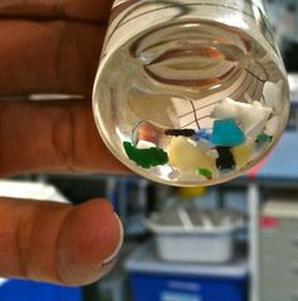
Image By: Julie Reisser/The Conversation
A sample of the microplastics collected in one 15-minute period in the coastal waters off Tasmania.
PERTH, AUSTRALIA — A University of Western Australia marine scientist has found the sea’s surface in Australian waters is contaminated by more than 4,000 pieces of tiny plastic per square kilometer.
Julia Reisser, oceanographer and PhD candidate at UWA, conducted a study quantifying plastic contamination in Australian waters. She told Plastics News the study is the first of its kind in Australia.
Australia’s overall mean sea surface plastic concentration is 4,256 plastic pieces per square kilometer. The mean value is higher than those reported for other regions, such as the Caribbean Sea (1,414 pieces per km2) and Gulf of Maine (1,534 pieces per km2).
“Until now, there was no at-sea survey focused on sampling plastic debris in Australian waters; plastic contamination was mostly inferred from beach clean-up reports,” Reisser wrote in an article for an Australian online news service, The Conversation.
As part of her research, Reisser boarded three Australian vessels on transit voyages and used a net to catch discarded plastic floating on the ocean’s surface.
She found mostly small fragments of hard plastic, but also soft plastics, including fragments of wrappers and fishing lines. Most were less than five millimeters across.
The majority of plastics she fished out were polyolefins (polyethylene and polypropylene). She said those polymers account for 52 percent of plastic production and are typically used to make throwaway packaging, and to manufacture fishing equipment, like crates, nets, ropes, and lines.
She found polyolefin fragments represented the majority of human-made debris on beaches, the seafloor, and in the water column. She said the fragments break down into increasingly smaller pieces due to the effect of sunlight and heat.
Reisser told Plastics News she was “curious about microplastics as a new research area. People are just starting to realize how widespread microplastics are. But it’s an expensive research area, which could explain why no one has looked into it until now.
“Researchers have previously been more concerned with macroplastics, those plastics that show up on the beach and are easier to see. There are more funds for that because the Australian government officially recognizes the issue of macroplastics polluting the ocean,” she said.
Reisser said marine plastic pollution was a global issue to which there was no simple solution.
She recommended decreasing plastic waste, improving plastic disposal practices on land at an international level, and better enforcing laws prohibiting dumping of plastics at sea.
Reisser told Plastics News she has an idea for a cost-effective system of policing plastic dumping by requiring people to report the amount of plastics they take to sea and how much they bring back.
But she said much of the microplastics that end up in the ocean come from land-based sources, and Australia should work with neighboring countries to establish an effective waste-management system, as there are currently no international laws for land-based waste management.
Reisser said further research is needed. “There is still lots to learn. We don’t know yet how long the microplastics have been there. I would also like to conduct research over a longer time period, as there may be seasonal variations,” she said.
In a research article she co-published on plosone.org, an international, peer-reviewed, online journal, Reisser suggested “further at-sea studies on the characterization, spatial distribution, and pathways of marine plastics in coastal and oceanic regions around Australia, as well as on marine plastic toxin loads and interactions between small plastic particles and organisms at all trophic levels of the food web. This would improve our current knowledge on the effects of plastic on the marine ecosystem as a whole.” |